Buzzers, Bunting and Bragging Rights: Inside Britain's Tiniest Game Shows

Photo: garden shed fairy lights quiz night neighbours bunting, via i.pinimg.com
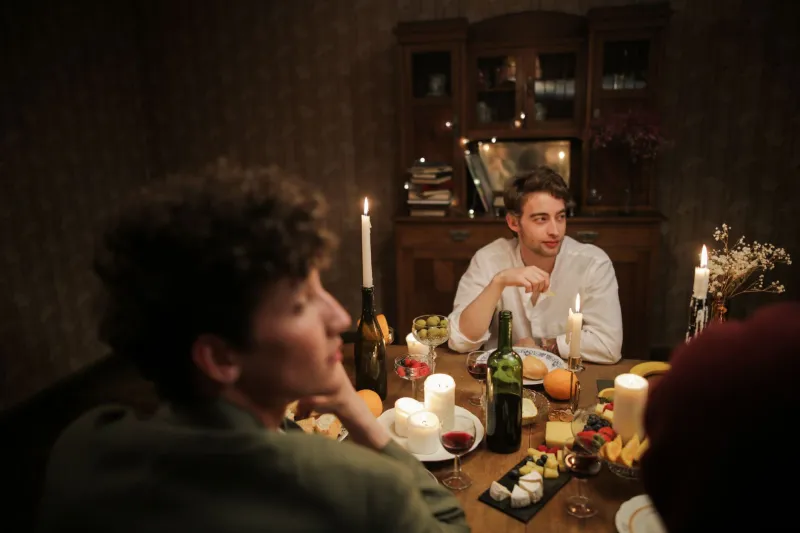
There is a moment, roughly eight seconds before the first question, that Marcus Hall describes as “the bit telly can't do”. Six people are crammed into his garage in Sheffield. The strip lights are on. Somebody's brought crisps. His daughter is holding a scoreboard made from a cereal box, and the buzzer — a doorbell switch wired to a bike bell and a battery pack — is doing a nervous little rattle on the workbench. Then he says “question one”, and the room goes so quiet you can hear next door's extractor fan.
“No adverts, no warm-up man, no scrolling,” he says. “Just six people who all actually want to be there. It's the best night of my month.”
Marcus is one of a growing number of people hosting what you might call micro game shows: small, invite-only competitions staged in whatever space they happen to have. A shed. A garage. A conservatory with a rug that has seen things. They are not quiz leagues, and they are emphatically not pub quizzes with the tables rearranged. They are formats — with rounds, rules, intervals and prizes — designed for an audience of about six.
The garage with the good buzzer
Marcus's show has been running since early 2024, when a power cut killed a planned takeaway-and-film night. Four rounds, twenty-five minutes, six contestants, one host. Round one is general knowledge. Round two is a sound round, played off his phone through a speaker that lives in the garage for exactly this purpose. Round three is “What's in the bag?” (he does not elaborate, and says the mystery is the whole point). Round four is sudden death, which is really just round one again but faster.
The prizes are the best bit. Nobody is playing for a car. “Last month's winner got a fiver for the bakery on the corner and a jar of honey from my mum's neighbour,” says Marcus. “The month before, a tea towel. The trophy is an old paint tin I sprayed gold, and it goes back in the cupboard the next morning. It's not about the prize. It's about being handed something by someone who knows your name.”
There is, he admits, a dress code, which he invented two summers ago and now enforces with mock seriousness. “Smart-casual-ish. The joke is that nobody owns anything smart-casual-ish. Dave turned up in a wetsuit once as a protest.”
The conservatory with a very strict tin
Two hundred miles south, in Stroud, Priya Raghavan runs something altogether more civilised. Her conservatory seats eight if everyone agrees to be friendly, and the format is teams of two rather than solo contestants — partly because it's kinder, partly because it means four households can play at once.
The Conservatory Championship has a proper running order printed on card. There is a welcome, a warm-up round of “easy questions to settle everybody's nerves”, a picture round, a sauce-identification round that has caused genuine family friction, and a final round she calls “the long shot”, where teams wager points they may not have.
“The rules are on the back of the door,” she says. “Phones go in the biscuit tin. Not because I'm a tyrant — because the whole evening changes when nobody's half somewhere else. You can see it. The first ten minutes, everyone's twitchy. By the sauce round, they've forgotten they ever had a phone.”
The tin, a battered Hobnobs one with a dent in the lid, is arguably the star of the show. So is the rosette, sewn by Priya's neighbour, which is pinned to the winning team's door handle and then — this is in the rules — returned the following week.
The one with an interval
North of the border, Callum and Eilidh Bryce have taken a different approach entirely: the interval. Their shed in Dumfries holds ten at a squeeze, which means five teams of two, and the whole thing is built around a fifteen-minute break with tea, a sliced loaf and a tub of butter.
“It started because the shed was too small to do it all in one go without someone getting tetchy,” says Callum. “Now the interval is the part people talk about. You get the gossip, you get the recriminations, you get somebody saying ‘I knew that’ about a question they absolutely did not know.”
Their format includes a half-time challenge in the garden — a bean-bag throw, a bucket, a stopwatch — which is cancelled without apology if the weather is Scottish. The prizes lean local: a chip-shop voucher, a bag of good coffee, and the Golden Spoon, a wooden spoon painted gold that has become, by mutual agreement, more prestigious than it has any right to be.
Why a shed beats a sofa
The obvious explanation is telly fatigue. It's a long evening when every show has an ad break, a phone-along and a companion podcast, and everyone in the room is watching a different screen. A six-person game show has none of that. It has roughly the same appeal as a good dinner party, with the added advantage that nobody has to make conversation for three hours solid.
“You're being watched by six people who know you,” says Priya. “That's a completely different feeling to watching strangers be watched. You get nervous in a nice way. It's a laugh, but it's also — I don't know — a bit of attention, in a small room, with crisps. People are short of that.”
Then there's the money angle, which nobody wants to lead with but everybody mentions. A night out is £40 before anyone's eaten. A shed show is a jar of honey, a tea towel and whatever's in the cupboard.
And there's the etiquette, which is quietly doing a lot of work. Phones in the tin. Bring something for the table. Don't correct the quizmaster, even when the quizmaster is catastrophically wrong. Win graciously. Host in rotation, so the same person isn't doing all the admin. End before anyone's tired — Marcus's twenty-five minute rule is treated locally as gospel.
How to start one tonight
Keep it small, keep it short, keep it cheap. Six contestants is plenty; ten is a crowd. Twenty-five minutes of questions is more than most people think. Write the rounds down — half the charm is the running order on card. Buy one buzzer and let them fight over it. Set a prize budget of under a fiver and stick to it. Put a tin by the door.
And don't over-prepare. Marcus wrote his first ever round on the back of a delivery note while the kettle boiled, and it remains, by his own reckoning, one of the better ones.
“The trick is that it feels like an occasion,” he says. “You don't need lights or a set. You need six chairs, a bit of bunting if you've got it, and someone willing to say ‘question one' and mean it.”