Six Chairs, One Hob, Zero Menu: The Spare-Room Restaurants Brits Are Booking Out
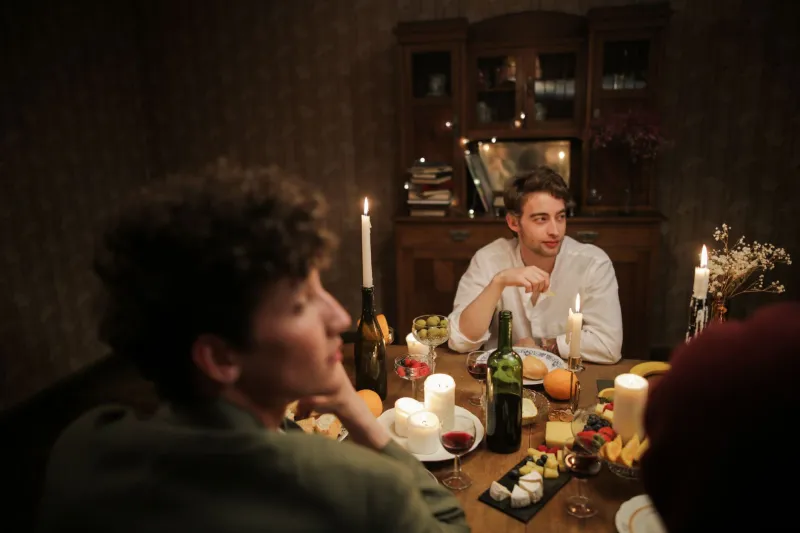
On a wet Tuesday in Leeds, six strangers are squeezing past each other to reach a table in a spare room. There is no sign outside, no card machine and no menu. There is a nurse in the kitchen, a borrowed chair that wobbles, and a pot of something that smells like a Sunday. Dinner costs £30. You eat what you are given. You leave with at least one new phone number.
Welcome to the six-seat supper club, the most bookable table in Britain in 2026.
For years, the big night out was a reservation with a waitlist, a dress code and a social media strategy. Now a growing number of diners are trading the polished dining room for a domestic one. The rules are simple: six guests, one set menu, no choices, no rush. The host cooks. The guests talk. The room is usually a spare bedroom, a dining room or a conservatory with a good lamp.
It is not a restaurant, exactly. It is not a dinner party, either. It sits somewhere between the two, and that is exactly why people are into it.
The nurse who cooks for six after a twelve-hour shift
Nadia, 34, is a paediatric nurse in Leeds. Once a month, she hosts what she calls The Sixth Chair: six people, £30 a head, one sitting on a Sunday. She cooks from her grandmother's recipes, mostly things that can be made in a big pot and left alone. Lamb and orzo. A tray of roasted peppers. Something with cardamom and far too much butter.
She started in 2024 after realising she spent all week making decisions for other people. 'At work I am constantly choosing what to do next,' she says. 'Here I make one decision: dinner. Then I sit down.'
Her spare room has a table that seats six if nobody leans back too far. Guests bring their own wine. She asks for dietary needs in advance, but there is no menu to choose from. 'People think they want options,' she says. 'What they actually want is to stop deciding.'
Her bookings open on the first Sunday of the month and are usually gone by Monday lunchtime. She has a waiting list. She has never advertised. 'It is not a business,' she says. 'It is a dinner that got out of hand.'
The retired bus driver with a route map of recipes
Colin, 67, drove buses in Cardiff for thirty-one years. Now he runs Terminus Suppers in the back room of his bungalow. Six seats. £25. A set menu that changes with the season and whatever the market has going cheap. Welsh lamb in spring, leek bread in autumn, rhubarb in a crumble that he insists is too sweet and serves anyway.
He treats guests like passengers. Everyone gets a seat, a story and a gentle nudge to be on time. 'I spent three decades keeping to a timetable,' he says. 'Now I cook for people who turn up when they say they will.'
Colin started hosting after his wife died. He did not want to eat alone, but he also did not want to join a club. A neighbour suggested a supper club. He misunderstood and cooked for six. It went well. He kept going.
His guests are a mix of regulars, neighbours and people who found him through a friend of a friend. He does not use Instagram. He has a texting list. He asks people to bring nothing but appetite, though he has been known to accept a bottle of something cold.
'People think small means amateur,' he says. 'It means careful. I have six people. I can remember what everyone is drinking.'
The teenage baker who turned revision breaks into a supper club
Maya, 17, is doing her A-levels in Bristol. Once a month, she hosts Crumb Club in her parents' dining room. Six seats, £15, a set menu of focaccia, pasta and a brownie that has developed a small following. Her parents do front of house. Maya does the cooking, the plating and the very teenager-specific task of asking everyone to be quiet while she checks the oven.
She started by baking after school and giving the results to neighbours. Then she charged for it. Then she set a date. 'I wanted feedback that was not a like,' she says. 'You cannot pretend a brownie is good when someone is sitting opposite you.'
Her guests are students, neighbours, friends of her parents and the occasional person who saw a flyer in a café. She posts the menu on Instagram the day before, but never the full details. The mystery is part of it. So is the price. Fifteen pounds is not nothing, but it is not a night out in the city either.
'We are not trying to be a restaurant,' she says. 'We are trying to be a good Thursday.'
The rules of a six-seat room
Every host has their own version, but the unwritten rules are remarkably consistent. Arrive on time. Tell the host about allergies in advance. Bring cash. Do not ask for a substitution. Stay until the conversation finds its own end, but leave by half ten. And do not treat the host like a waiter.
The no-menu rule is the one that surprises people most. In a big restaurant, choice is the point. In a six-seat room, choice is noise. The host has already made the decision. Your job is to trust it. That trust is the whole experience.
It also keeps costs down. One menu, one shop, one cook. There is no waste and no kitchen brigade. The host can spend the money on better ingredients rather than on a website.
Why 2026 is the year of the tiny table
Part of it is money. A big night out has become a big bill. Part of it is noise. We are tired of shouting over music in rooms designed for turnarounds. But the deeper reason is simpler: people want proof of other people. A six-seat supper club is not content. It is a room with a smell and a wobbling chair and someone who remembered that you do not eat mushrooms.
The scene is not new. Britain has had underground restaurants and pop-up kitchens for years. What feels different in 2026 is the scale. These are not aspirational dining rooms with a waiting list and a PR agent. They are spare rooms. They are a nurse, a retired bus driver and a teenager with a good brownie recipe.
It is the anti-bottomless brunch. It is the opposite of the polished influencer dinner. You cannot film it properly because the light is terrible. You cannot order it differently because there is no menu. You can only sit down, eat what you are given and talk to the person next to you.
That might be the best reservation in Britain right now. Just do not lean back too far.